

How do we navigate difficult conversations?
Dealing with the hard stuff

For most of us, we will have to find ways to communicate with others who don’t always see things the same way that we do. Not only do we need to be able to have these conversations, but so much of the time it is a challenge to have the conversation because of different perceptions, assumptions, feelings, etc. In this post, I’m going to share some brief tools to navigate these difficult conversations and what we can do to approach these conversations in healthy, meaningful ways.
Tools:
1: Create an environment of safety
Sometimes we do not create an environment where it is safe to talk about a difficult topic. For example, we may approach a conversation at an inopportune time such as in a public setting, or when the other individual is exhausted and under too much stress to talk about the subject. Components to keep in mind are:
Finding a way to shared purpose. Both individuals need to care about the wellbeing of the other in order to address the concern. If there is no shared purpose, there will be a lack of safety.
Be respectful of one another. When disrespect enters a conversation, then the focus is no longer on the topic, but rather is putting one in a state of defensiveness. Respect is crucial to creating safety and can be shown by understanding that the other individual may not be capable of having the discussion right now if they are tired.
2: Actively listen
The vast majority of people focus on being understood in a conversation - they just want to get their point across and for the other person to hear them. The problem is, we then aren’t listening to the other individual because we are both fighting for the first to be understood. Instead, approach the conversation with openness and curiosity for the other person. Skills for actively listening can include, but aren’t limited to some of the following:
Quiet your own voice. When the other person is speaking, many of us are crafting what our response will be next. Check it out if you don’t believe me, just notice during a conversation if your brain is coming up with a response while the other person is speaking. We aren’t able to fully listen while we are creating a response, so when you notice that happening, quiet the mind by internally noting you’re drifting and coming back to being curious about the other person.
Ask open-ended questions. Open ended questions are questions that allow someone to expand on their points. It goes beyond the ‘yes,’ or ‘no,’ responses and creates space for the other to really share their perspective.
Adopt a non-judgmental and emotionally validating stance. It can be heard to listen to someone talk about a difficult topic or an area of contention between the two of you, and they may express feelings of disappointment, anger, or frustration with you. Acknowledge the emotions they share without any condemnation about their experience. Allow them to share.
Clarify. Paraphrase back to them in your words what you heard them say and ask if you are correct in what you heard. By paraphrasing, you are showing that you heard them, and it gives them a chance to correct anything that you may have misinterpreted.
3. Hold a ‘yes, and…’ position
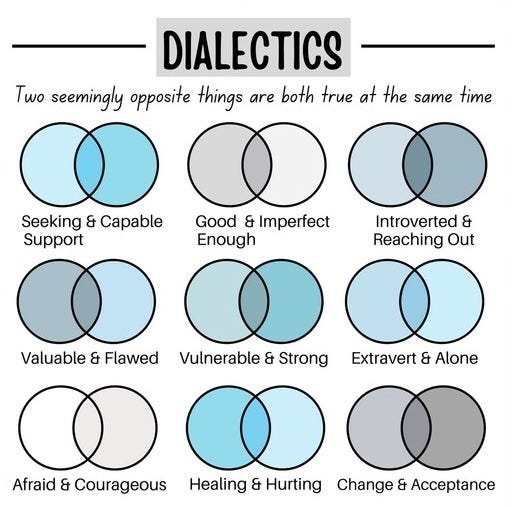
Difficult conversations are not always resolved. They do not always result in both parties being able to walk away with an agreed upon solution. There may not be a compromise. For example, there may be difficult conversations surrounding values or beliefs. Just because you can validate and appreciate the other individual, it does not mean that you have to abandon your stance within the conversation. This is held in the concept of dialectics. In the below image, you will see an example of things that may be perceived as opposites and yet, can be true simultaneously. The crucial component of this piece in conversations is that both individuals are able to express their views and listen to the views of the other person as well.
4. Use “I” statements
Assertive communication allows us to communicate our wants and needs in a helpful way that does not assign blame towards the other. An essential component associated with assertive communication is the use of “I” statements. We may want to use “you” statements when in a conversation that is challenging because it’s pretty direct and pointed and keeps us from being vulnerable.
Helpful Example:
I feel hurt when you interrupt me.
Unhelpful:
You are interrupting me.
I feel __(emotion)__ when __(action).
5. Separate Impact vs. Intent
Have you ever had the experience of being in a store or somewhere and seeing a friend? You lock eyes and you smile and wave across the store like a crazy person and the other person looks away pushing their cart to another isle… YIKES right?!? Suddenly the excitement that may have shown up seeing a friend in the store is gone and instead, confusion. You think to yourself, ‘they saw me, we locked eyes.’ We can guess the next thoughts - ‘what did I do, do they not want to be seen by me, what’s wrong with them, what a jerk, etc.’ That is ALL assumption. We do it all the time because our brains love stories. In challenging conversations we have to be really careful to notice these assumptions separating impact and intent.
What did they actually say/do?
How does it impact me?
What assumptions am I making about the other person’s intent based on how it is impacting me?
Application example:
I felt irritated when you were running late and didn’t tell me. I don’t like being late for events and since we were riding together it created a lot of stress for me. Because you were running late and didn’t tell me, I assumed you didn’t care that we would be late for the event.
6. Future contributions
How did we both contribute, if at all, and how do we do things differently? This is arriving at a collaborative solution on how to manage this in the future.
Conclusion
There are a lot of different things that we could talk about when it comes to navigating difficult conversations. Throughout this post, we focused on a low level emotional intensity experience, but many people in the current culture are experiencing increasingly difficult conversations whether it is conversations about values, ethics, beliefs, politics, the future, etc. I have spoken with individuals who are struggling to know how to have conversations with family because they are struggling to determine when they need to leave their job or the country. Others have shared holding different values within their homes and how current sentiments are dividing the home because of the value differences. In the case provided within this post, there is a way to navigate to a solution, but that is not always the case. There may be no solution that both individuals appreciate. Some of us are asked by our jobs to do things that we are not willing to do and are being faced with challenges of determining how to navigate conversations with supervisors where there may not be a solution which is scary on multiple fronts. AND, please know, none of us are alone.